








Your Success, Our Mission!
3000+ Careers Transformed.


Contextual & Knowledge Graph-Based Recommendations
Last Updated: 29th January, 2026Incorporating User Context and Behavior
In the real world, user preferences don’t exist in isolation — they change continuously depending on context. Context-aware recommendation systems are designed to consider factors such as time of day, location, device type, or even emotional state when generating suggestions. For example, a user might watch educational videos during weekdays but prefer light entertainment over weekends. Similarly, food delivery apps like Zomato or Swiggy might recommend different cuisines depending on the time (breakfast vs. dinner) or weather (hot soup on rainy days).
These systems work by embedding contextual information into the recommendation process. In practice, this may involve adding features like “time of interaction” or “user device” to the model input, or building separate models for different contextual scenarios. Advanced architectures use contextual embeddings and factorization machines to learn how these variables influence user choices. Over time, the model identifies complex dependencies — for instance, how a user’s movie preferences shift between weekdays and weekends or how their product choices vary across locations.
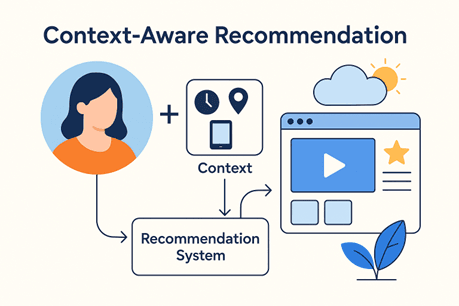
Context-aware recommenders thus move beyond static personalization, offering dynamic, situationally relevant experiences. They create a more human-like understanding of user intent, ensuring that recommendations feel timely, natural, and intuitive. This approach is especially powerful for streaming platforms, travel apps, and e-commerce sites where real-time adaptation significantly enhances engagement and satisfaction.
Introduction to Graph Neural Networks for Recommendation
As the digital ecosystem becomes more interconnected, recommendation problems increasingly resemble graphs — networks of users, items, and their relationships. In such settings, Graph Neural Networks (GNNs) have emerged as a cutting-edge framework for modeling these complex relationships. In a recommendation graph, nodes represent users or items, and edges represent interactions (like ratings, purchases, or clicks). GNNs propagate information across these edges, allowing the model to capture higher-order connections — such as “users who liked this item also liked others connected to similar users.”
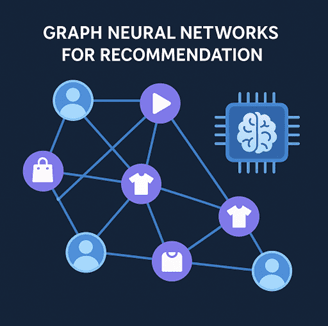
This relational understanding goes beyond simple user–item similarity. For instance, a GNN-based movie recommender might identify that two users who haven’t watched any of the same movies are still related through shared directors, genres, or actors — enabling intelligent, explainable recommendations. By aggregating signals from neighboring nodes, GNNs learn rich, context-aware embeddings for each user and item.
Modern frameworks like PyTorch Geometric and Deep Graph Library (DGL) simplify building such systems. Developers can define layers that perform graph convolutions, updating each node’s embedding based on its neighbors. The resulting model can then be used for link prediction — essentially, forecasting which new connections (interactions) are likely to form. This makes GNNs especially suitable for large, relational datasets such as those used by YouTube, Alibaba, or Pinterest.
Ultimately, GNN-based recommender systems mark the next evolution in personalization — combining structure-aware learning, contextual reasoning, and deep neural representation. They represent how machine learning is evolving from pattern recognition to relationship understanding in the domain of recommendations.
Module 4: Hybrid and Context-Aware Systems
Top Tutorials
Related Articles

Made with in Bengaluru, India


- Courses
- Advanced Certification in Data Analytics & Gen AI Engineering
- Advanced Certification in Web Development & Gen AI Engineering
- MS in Computer Science: Machine Learning and Artificial Intelligence
- MS in Computer Science: Cloud Computing with AI System Design
- Professional Fellowship in Data Science and Agentic AI Engineering
- Professional Fellowship in Software Engineering with AI and DevOps
- Join AlmaBetter
- Sign Up
- Become A Coach
- Coach Login
- Policies
- Privacy Statement
- Terms of Use
- Contact Us
- admissions@almabetter.com
- 08046008400
- Official Address
- 4th floor, 133/2, Janardhan Towers, Residency Road, Bengaluru, Karnataka, 560025
- Communication Address
- Follow Us

© 2026 AlmaBetter