








Your Success, Our Mission!
3000+ Careers Transformed.


Deploying a Recommendation API
Last Updated: 29th January, 2026FastAPI Implementation
Once the model is trained and tested, it’s time to deploy it as an API, enabling access from web apps, dashboards, or external systems. FastAPI, a modern Python framework, is ideal for this task due to its speed, simplicity, and automatic documentation generation.
The process begins by saving the trained model (for example, as a .pkl file) and loading it within a FastAPI endpoint. Each API route defines specific functionality — one route might return the top 10 movie recommendations for a given user, while another could return similar movies for an input title. Using FastAPI’s built-in support for Pydantic models, we ensure proper validation of incoming data.

Example workflow: a client sends a GET or POST request (e.g., /recommend?user_id=10), and the API responds with JSON-formatted results containing recommended movie names, genres, and scores. FastAPI also integrates easily with Uvicorn for local testing and Docker or AWS Lambda for scalable cloud deployment.
Moreover, API performance monitoring can be added using tools like Prometheus or New Relic to track latency and request volume. By turning the model into a RESTful API, we transform it from a local prototype into a reusable, production-grade service — the foundation for all modern recommendation-driven applications.
Streamlit Dashboard for Interactive Recommendations
While the FastAPI service handles backend delivery, Streamlit provides a simple yet powerful interface for frontend visualization. In this lesson, we connect the deployed API to a Streamlit dashboard, allowing users to request and view recommendations dynamically.
The Streamlit app sends requests to the API endpoint (e.g., /recommend?user_id=15), retrieves the JSON response, and renders it using clean, interactive components.
Users can select filters such as movie genre, rating threshold, or number of recommendations. Each recommendation is displayed with its title, poster, and predicted rating. Behind the scenes, Streamlit uses caching and lightweight state management to keep the interface fast and responsive.
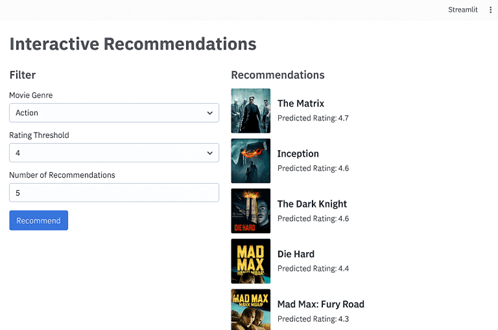
We can further enhance the experience by adding charts that summarize user preferences or visualize embeddings in 2D space. The dashboard might also include an admin view showing model metrics (like RMSE trends) and system logs. Finally, deploying the Streamlit app to Streamlit Cloud, AWS, or Heroku makes the entire project accessible to end users or stakeholders.
Conclusion
Congratulations on completing “Building a Recommendation System using Deep Learning: A Beginner’s Guide”!
You’ve just unlocked one of the most exciting areas in Data Science — the art and science of personalization. Throughout this journey, you explored how platforms like Netflix, Spotify, and Amazon use recommendation systems to transform user experiences through intelligent data-driven suggestions.
We began by understanding the fundamentals of traditional recommenders, including Content-Based and Collaborative Filtering techniques. You learned how these systems identify similarities between users and items, leveraging ratings, preferences, and features to predict what comes next.
Then, we stepped into the Deep Learning era, where models like Neural Collaborative Filtering (NCF), Autoencoders, and Sequence-based architectures (RNNs, GRUs, LSTMs) revolutionized personalization. You saw how these architectures can capture subtle, nonlinear relationships and adapt dynamically to evolving user behaviors.
Later, we explored Hybrid and Context-Aware Systems, combining the strengths of multiple approaches and integrating user context — making recommendations smarter and more human-like. Finally, you applied your knowledge to a real-world MovieLens project, building, evaluating, and deploying a working recommendation API and interactive dashboard.
At this point, you’ve gained both theoretical understanding and practical, hands-on skills — from feature engineering and model design to deployment with FastAPI and Streamlit. You are now fully equipped to design intelligent, scalable, and personalized recommendation systems that can power next-gen applications across industries.
What’s Next? Join the AlmaBetter Journey!
If this tutorial sparked your curiosity, it’s just the beginning.
At AlmaBetter, we take your learning beyond theory — into real-world, project-based mastery.
Here’s how you can take the next step:
Enroll in AlmaBetter’s Full Stack Data Science Program to master advanced ML, Deep Learning, and NLP.
Get hands-on with industry-grade projects, personalized mentorship, and career guidance.
Learn from experts building real AI systems — and get placement support to launch your data career.
Don’t just learn how recommendation systems work — learn how to build them for real-world impact.
Start your journey with AlmaBetter today — where learning meets opportunity.
Additional Readings
Certainly! To deepen your understanding of recommendation systems and their applications, here are some insightful articles from AlmaBetter:
Types of Recommendation Systems: How They Work & Use Cases
Recommender System In Machine Learning with 6 Examples
How Netflix Uses ML & AI For Better Recommendation for Users
Mastering Deep Learning Algorithms: A Comprehensive Guide
Difference between Deep Learning and Machine Learning
These resources will provide you with a comprehensive understanding of recommendation systems, from foundational concepts to advanced applications in the industry.
Module 5: End-to-End Project and Deployment
Top Tutorials
Related Articles

Made with in Bengaluru, India


- Courses
- Advanced Certification in Data Analytics & Gen AI Engineering
- Advanced Certification in Web Development & Gen AI Engineering
- MS in Computer Science: Machine Learning and Artificial Intelligence
- MS in Computer Science: Cloud Computing with AI System Design
- Professional Fellowship in Data Science and Agentic AI Engineering
- Professional Fellowship in Software Engineering with AI and DevOps
- Join AlmaBetter
- Sign Up
- Become A Coach
- Coach Login
- Policies
- Privacy Statement
- Terms of Use
- Contact Us
- admissions@almabetter.com
- 08046008400
- Official Address
- 4th floor, 133/2, Janardhan Towers, Residency Road, Bengaluru, Karnataka, 560025
- Communication Address
- Follow Us

© 2026 AlmaBetter