

Your Success, Our Mission!
6000+ Careers Transformed.
Explanation
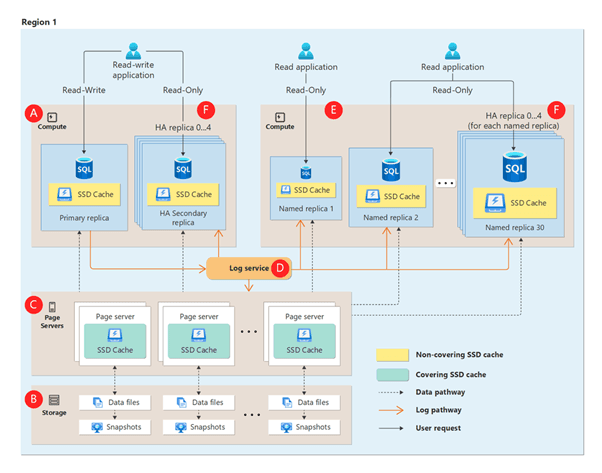
Azure SQL Database is a fully managed relational database service built on the Microsoft SQL Server engine. It removes the need for infrastructure management tasks such as patching, backups, and high availability configuration. The service provides automatic scaling, built-in fault tolerance, and advanced security features including encryption, auditing, and threat detection. Azure SQL Database supports transactional workloads and integrates seamlessly with applications hosted on Azure compute services. It operates under a platform-as-a-service model, allowing developers to focus on schema design, queries, and performance optimization rather than database administration.
Table
| Feature | Description |
|---|---|
| Automatic Backups | Enables point-in-time restore capability |
| High Availability | Built-in data replication for reliability |
| Security | Encryption, access control, and auditing support |
| Scaling | Elastic compute and storage scaling based on demand |
Image Placeholder
Example
An e-commerce platform uses Azure SQL Database to store customer orders and payment records. Automatic backups ensure data can be restored in case of errors. During peak shopping seasons, the database scales to handle increased transactions. Security features protect sensitive financial data. Developers focus on optimizing queries instead of managing servers. The platform remains reliable and compliant with minimal operational effort.
Use Cases
• Transactional business applications
• SaaS application databases
• Financial and inventory systems
• Secure data-driven applications
Explanation
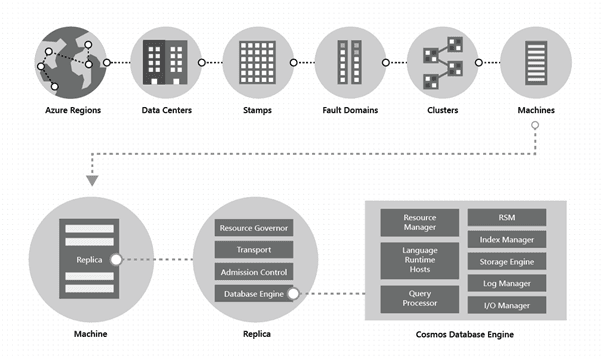
Azure Cosmos DB is a globally distributed, fully managed NoSQL database service designed for low-latency and high-throughput applications. It supports multiple data models and APIs, enabling developers to choose the most suitable structure for their application needs. Cosmos DB automatically replicates data across regions and provides configurable consistency levels to balance performance and data accuracy. It uses a throughput-based pricing model, allowing precise control over performance and cost. The service is ideal for modern, cloud-native applications that require scalability and global reach.
Table
| Feature | Purpose |
|---|---|
| Global Distribution | Provides low-latency access worldwide |
| Multi-Model APIs | Supports flexible data models (SQL, MongoDB, Cassandra, etc.) |
| Consistency Levels | Enables tunable performance and data consistency |
| Throughput Units | Allows precise performance and request rate control |
Image Placeholder
Example
A global gaming application stores player profiles in Azure Cosmos DB. Data is replicated across regions to ensure fast access for users worldwide. The application selects a consistency level that balances performance with accuracy. During peak usage, throughput is increased to handle demand. Latency remains low regardless of user location. The system scales seamlessly without downtime.
Use Cases
• Globally distributed applications
• Real-time data processing
• IoT and telemetry storage
• High-scale mobile and web apps
Microsoft Azure has evolved into a comprehensive cloud ecosystem that supports everything from simple applications to globally distributed, mission-critical systems. Through this tutorial, the foundational concepts of cloud computing, Azure architecture, compute, storage, networking, databases, security, DevOps, monitoring, and advanced services have been structured in a progressive and practical manner. Each concept was designed to build not just theoretical understanding, but also architectural thinking aligned with real-world use cases.
For beginners in 2026, Azure is more than a platform—it is a skill set that directly maps to industry demand. Understanding how Azure services interact, scale, and secure workloads prepares learners for hands-on implementation, certifications, and professional roles in cloud engineering, software development, data, and DevOps. This guide forms a strong base upon which advanced architectures, optimizations, and specializations can be confidently built.
• Microsoft Azure official documentation
• Azure Architecture Center reference designs
• Azure Well-Architected Framework
• Microsoft Learn Azure Fundamentals learning paths
• Azure certification guides (AZ-900, AZ-104, AZ-204)
• Cloud design patterns and best practices
• Azure security and compliance documentation
For 2026, Microsoft Azure has become even more central to the tech landscape, especially with the deep integration of Agentic AI and Cloud-Native AI System Design. AlmaBetter offers a variety of resources through their "Bytes" platform and specialized programs to help beginners navigate this ecosystem.
These guides provide a foundational understanding of Azure services and their application in modern DevOps and AI workflows.
AlmaBetter maintains a central hub for tech cheat sheets. While many are general, they are essential for the scripting and infrastructure-as-code (IaC) side of Azure.
If you are looking for a structured, long-term program that includes Azure as a core pillar, AlmaBetter has launched specialized degrees:
Top Tutorials
Related Articles

 in Bengaluru, India


All Courses (6)
Master's Degree (2)
Fellowship (2)
Certifications (2)


 Relational Databases & NoSQL Databases


 in Bengaluru, India